

Listening Guide: Introduction to the New Orleans Style
Why "A Monday Date" Matters
Few recordings introduce the New Orleans style as clearly as Louis Armstrong's "A Monday Date." Recorded in Chicago during the legendary Hot Five and Hot Seven period this performance captures the quintessential aspects of early jazz including: collective improvisation, solo breaks, stride piano playing, hand-held hi-hats (badock cymbals), contrasting ensemble textures, Louis Armstrong’s unmistakable command of the ensemble through his playing, singing, improvising and rhythm
It’s also great to hear the banter of Armstrong with Earl “Fatha” Hines at the top of the track. After that back and forth, Armstrong says, “Come on Zutty! Whip them cymbals, Pops.” This is a sonically clear introduction to the badock cymbals. These were hand-held cymbals (often referred to as badock cymbals), predecessors of the later sock cymbal and modern hi-hat.
What to Listen For
Some important things to listen for when we’re talking about early jazz.
Instrumental Roles
- Horn players are expected to play in time, understand harmony, and solo in their roles. They’re also expected to be able to play together in sections as we’ll explore later in a big band listening guide.
- The rhythm section even in its earliest forms is to provide a consistent pulse and swing feel, appropriate for the style. This rhythm section does not yet consist of a bass player, so the banjo and piano are acting in duality as bassists and comping (accompanying or complementing) instruments.
Collective improvisation
- The horns collectively improvise while the rhythm section keeps the form and swing.
Form
The “form” of a tune functions as a road map. Let’s think of the form as a driver in a car with one passenger.
- The driver of the car can function as the melody. It tells us where we’re going.
- The wheels of the vehicle function as the harmony. They help us get to where we’re going.
- The co-pilot functions as the improviser. They let us know when the route may change, but we still continue to the same destination. The form can include intros and outros. This is the added material beyond the run down of the melody.
- This form is AABA.
- The easiest way to listen to form is to listen for what is different. If the form is AABA, ¾ of the tune is an A section. Start there!
Swing
Listen to the type of swing that is being played. Does the swing sound more horizontal (triplet oriented) or more vertical (more sixteenth note oriented)? This can be revealed by the ensemble and how they interpret the melody and how they solo. It can most easily be recognized through how the rhythm section is playing the swing.
- Armstrong’s approach to rhythm
- Listen to how he uses rhythm within his interpretation of the melody (singing and playing) and when he’s improvising.
- Range
- Listen for the ranges of each instrument to better understand what to hear in the mix. This will help identify the instruments when the band is playing simultaneously.
I hope you enjoy our introduction to listening!
Here’s the full track. The timestamps used below will correspond to this version of the recording.
A Timeline of the Recording
0:00 - The Banter
The tune actually begins after the banter between Earl “Fatha” Hines and Armstrong. The tune itself is a gem as it easily demonstrates so many of the elements of what it means to put together an arrangement of a tune.
0:12 - Singleton’s cymbal break
After that, Zutty Singleton plays the break on hand held cymbals that open and close, similar to a hi-hat.* Even today, drummers are asked to “take 4 or 8 or a chorus out front,” which means to add that many measures before the tune begins. What’s curious about this is that Singleton plays 4 bars plus two beats, which is a bit odd. No matter, it gives the listener a less than expected entrance from the ensemble.
Understanding Collective Improvisation
0:22 - Collective Improvisation
The band is playing the last eight bars of the form and sticking to their “roles.”
Armstrong has the lead voice as the trumpeter, he’s playing the melody. Jimmy Strong (clarinet) is playing around the melody using eighth note lines and embellishing the melody. Fred Robinson on the trombone is outlining the bass notes and functioning partly as harmonic foundation.
Mancy Carr on the banjo is “chunking” all four beats in the measure and playing the chords. Earl Hines’ piano playing utilizes stride piano playing, where the left hand is playing the bass notes and the inner harmony while his right hand can be improvising in the top half of the piano. Singleton is somewhat lost in the mix. Due to the early electrical recording technology the drums were further away so that they wouldn’t overpower the band in the mix. Singleton’s placement and the banjo’s percussive attack may both contribute to how faintly some of his playing registers.
0:31
After the band plays the introduction, they play the head (the melody) down once.
1:05 - Armstrong’s vocal chorus
Then Armstrong comes in singing the tune solely accompanied by Fatha Hines. The distinct sonic change is jarring because the listener just went from hearing the entire band of six players utilizing collective improvisation, down to a duo. It’s also an excellent way to focus on the piano player’s expectations when playing in this style: everything!
1:36 - Armstrong’s first scat break!
Then they get to the last two bars of the form and break so that Armstrong can scat on his own until the transition into the trombone solo.
1:38 - trombone solo
Because of the 3-minute allotment for these recordings, there was a lot of information to pack into a short time span. A great way to do this is to break the solos up over the form. Instead of having a soloist blow (solo) over an entire chorus, the soloist blows over a section of the chorus. In an AABA format, that’s typically broken up into one soloist on the first two A’s, a different soloist on the B, and either a return to the first soloist or a different soloist on the last A.
On this recording the solos are trombone on the A sections and clarinet on the B section.
Notice that the trombone is only interpreting the melody until the last four bars of the second A. The banjo is the only comping instrument behind the trombone A sections.
1:54 - clarinet solo
The clarinet takes over for the B section and it’s still banjo but at the break for the clarinet on the last two bars of the B, we can faintly hear Singleton’s badock cymbals, making it possible that he was playing throughout the section. Perhaps his sound was eaten up by the banjo. You’ll see why in a minute.
2:01 - clarinet break
Then we get a clarinet break on the last two bars of the B which then hands it back off to trombone.
2:02 - trombone last A
The trombone again highlights the melody in his solo, but takes more soloistic liberty until the last two bars of the section.
2:09 - Armstrong!
Armstrong takes the break with a soaring eighth note line that leads into the next top of the form. Backgrounds (meant to be played in the background, simple rhythms that outline the harmony) enter from the clarinet and the trombone. The banjo is comping as well. This is an exciting moment as it is the first time a soloist is playing with the added backgrounds, creating a different texture for Armstrong. On the B section, the background “lay out” (remove themselves).
2:28-2:34 - the ride cymbal pattern…!
Once the B section occurs, the recording shifts with the addition of Singleton’s loud pattern keeping on the badock cymbals. The banjo can be heard playing a stronger emphasis on beats two and four in his comping. It’s the only time it happens throughout the track and when it does, it creates a new energy. When they return to the last A, the backgrounds again enter and alter the sound.
2:42 - final Singleton break
Armstrong gives Singleton the final break so we can again hear the badock cymbals loud and clear!
2:45 - Fatha Hines takes eight bars
From there Fatha Hines takes eight, similar to the intro.
2:53 - collective improvisation
The band returns with their collective improvisation and then we can hear the two and four from a small cymbal during this section.
3:00
The band ends by trading around two bar breaks with the horns, getting a slower rubato piano interjection and then back to the uptempo for the final two bar statement.
Try Listening Again
Try to focus on one thing at a time, maybe only the clarinet, or banjo. Maybe listen to the backgrounds to better hear the outline of the chords. Try to listen to the rhythmic language that Armstrong uses in his solo. I have a saying in my studio which encourages this rep-oriented practice: “More reps, less stress.” The more we listen to a track, the more we know about it. The more we know about it, the more we can enjoy it, implement it in our playing or just scrub back to the moment that makes us smile. Listening to music is a luxury to be enjoyed! Remember that every time you listen to a track, you’ll discover something new. That’s the beauty of our music.
Why this Recording Still Matters
“A Monday Date” reminds us how the time parameter is a gift in crafting arrangements. This in particular showcases the strengths of the ensemble and the effectiveness of texture. Through collective improvisation, different pairings of musicians, backgrounds, textures, solo breaks and foot tapping swing, “A Monday Date” puts the New Orleans sound on display. For listeners expanding their early jazz palettes, Louis Armstrong is an essential point of entry. Pops is Tops!
I hope this introduction to listening was interesting and helpful. Please continue reading to learn a little more about drummer Zutty Singleton, who was featured on this track.
Spotlight on Zutty Singleton
Zutty Singleton, born in Bunkie, Louisiana in 1898 was an important figure in drumset evolution, having recorded with Louis Armstrong, Jelly Roll Morton and Barney Bigard. Having met Armstrong in Fate Marable’s band, they hit it off as young bandmates. Their friendship experienced one long period of tension, but the two reconciled later in life. Below is a photo of one of his interviews with Stanley Dance for the Jazz Oral History Project, which is housed at the Institute of Jazz Studies at Rutgers in Newark, New Jersey. This is what Singleton is alluding to, his friendship with Armstrong and how he would have done anything to play with him.
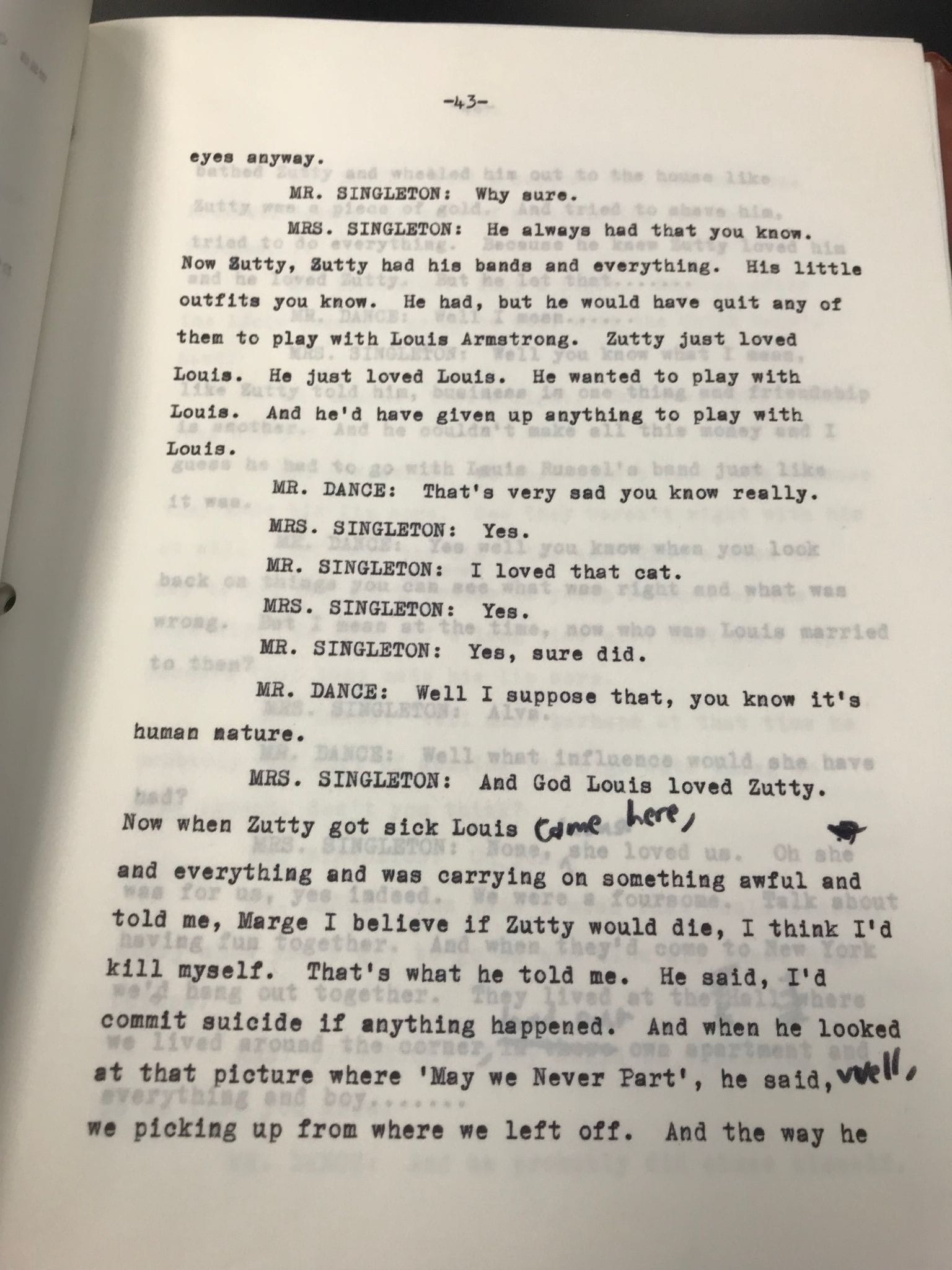
For more on that reunion, please see Ricky Riccardi’s Heart Full of Rhythm. Singleton had an impressive recording career as well as touring career, influencing the likes of Gene Krupa, who would watch him through the window of the club in Chicago.
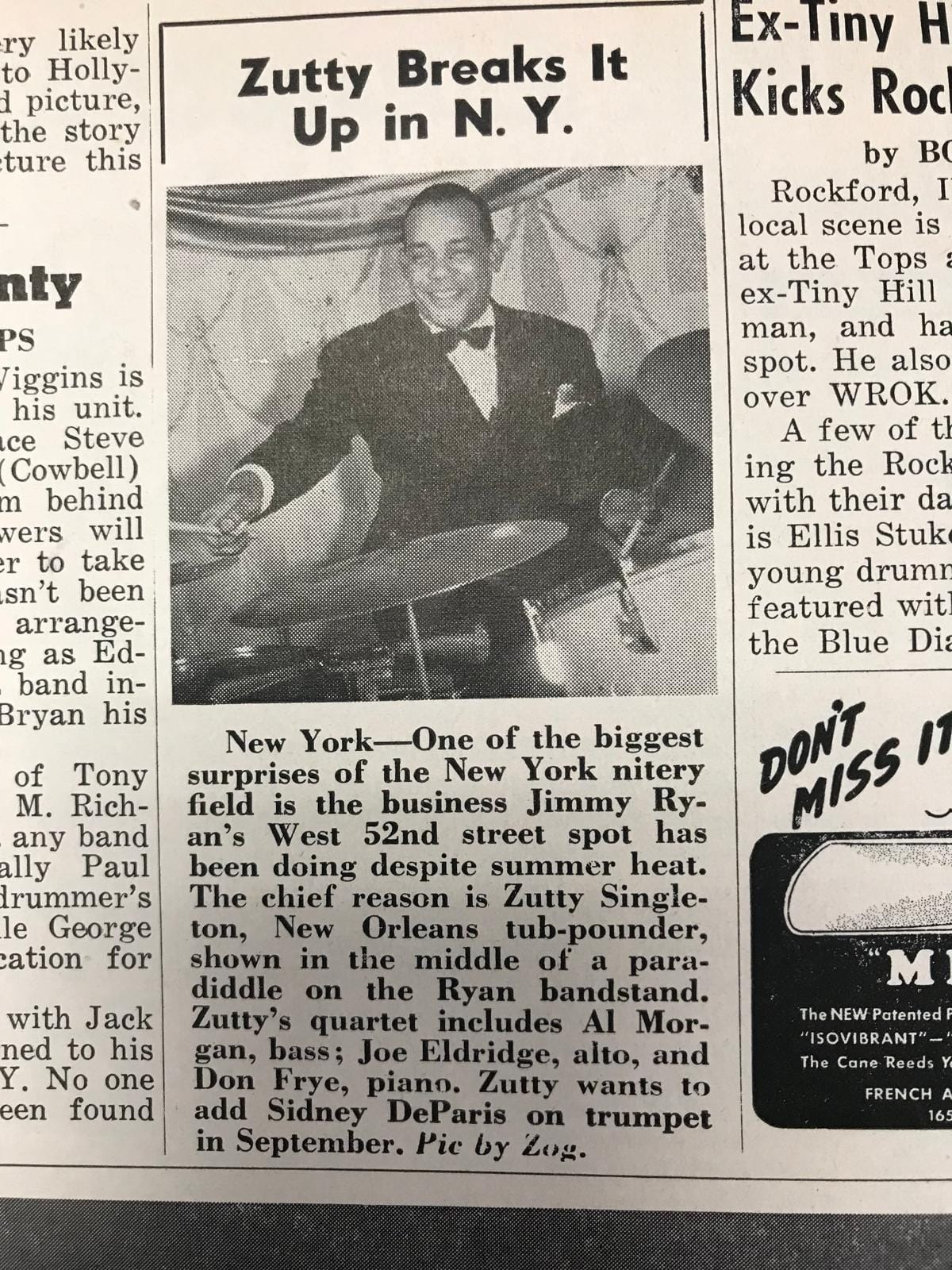
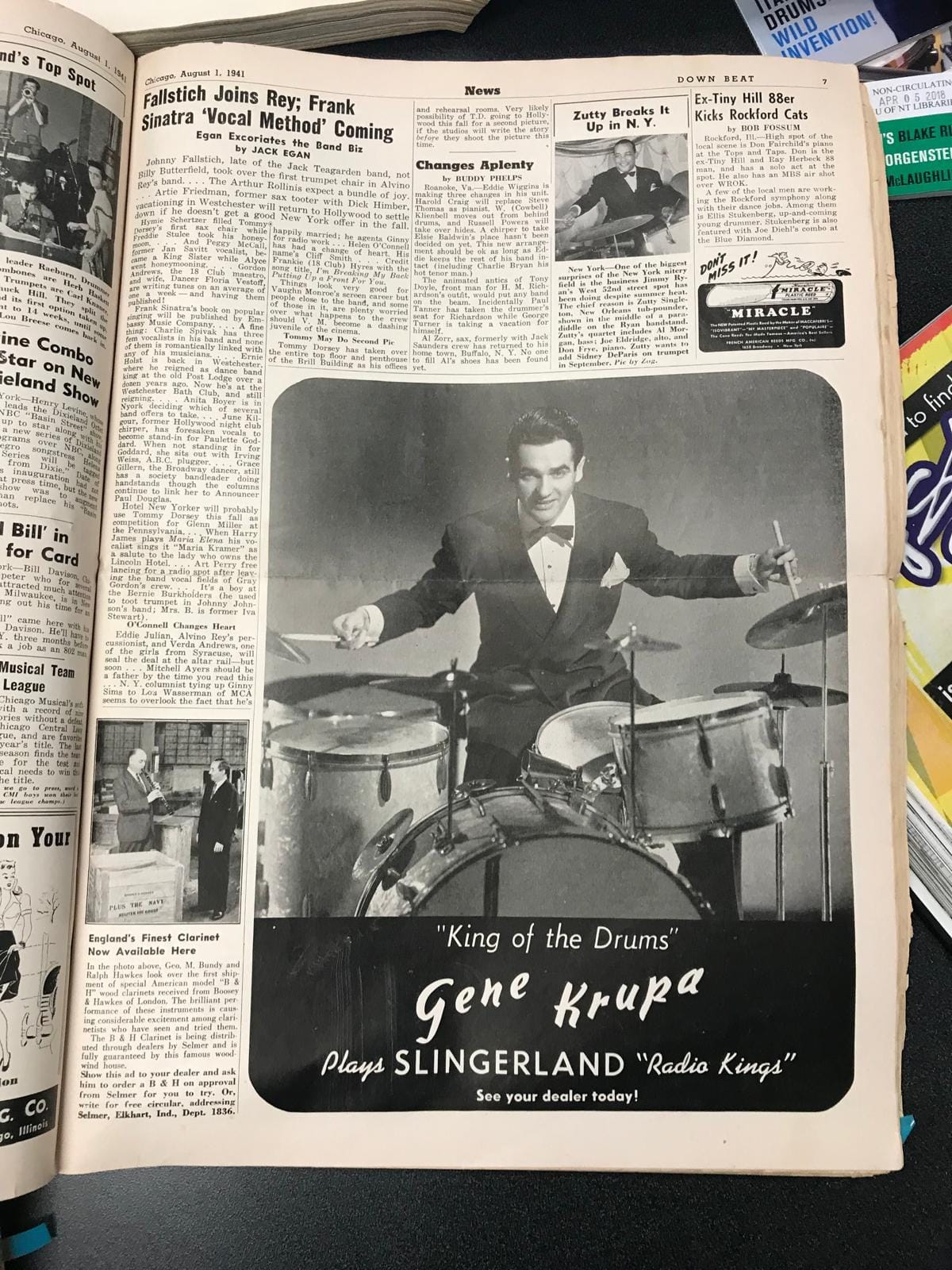
The December 1, 1941 page of Downbeat offers a visual summary of Singleton’s place in jazz history: Gene Krupa full page, Zutty Singleton top corner. Singleton’s influence on Krupa was notable, as Krupa would often watch Singleton in Chicago.
Singleton’s career reminds us that fame isn’t necessary for impact.
His history is as important as Krupa’s as it was Singleton’s creativity and output that helped make those later careers possible.
Access all areas
If you subscribe today, you'll get full access to the website as well as email newsletters about new content when it's available. Your subscription makes this site possible, and allows The Jazz Sentinel to continue to exist. Thank you!
If you believe in independent jazz journalism and want to become a founding member of The Jazz Sentinel, please click here.


